
Why I Became a Psychodramatist
Why I Became a Psychodramatist
by Regina Sewell, PhD/ MEd, LMHC, PCC, CP
True confession: When I started out, I didn’t want to be a therapist. I was an activist and I wanted to save the world. I wanted to be an academic because I believed that if I could gather the right data and write the right paper, I could make a difference.
And then I had a student. I’ll call her Vanessa. Vanessa changed everything. She called me from the hospital to tell me that she needed to make up the mid-term. She said that her father had “kind of gotten mad” at her. Per university protocol for make-up exams, I had her bring in the medical paperwork. I can still feel the kick in the gut I felt when I read the report. She’d been sexually assaulted by her own father. I didn’t know how to respond. I talked to my advisor. She had no clue what to do or say to a human being who had gone through that sort of trauma. Academics, at least in my department, did not “do” feelings. She told me to refer her to someone else. And that was the beginning of my journey.
I called the local rape crisis line to make sure that it was safe to refer them to Vanessa and they were wonderful. I realized that this is the way we actually save the world — one person at a time.
I don’t know if Vanessa ever contacted them**, but I became a volunteer. I answered the rape help line, facilitated rape education and prevention programs at schools, colleges, and in the community and worked on fundraising to keep the crisis center’s doors open. And then I got an opportunity to be an intern with the self-defense instructor and was able to teach feminist based self-defense. It was awesome. I was creating a space for people to talk about their experiences, teaching them how to set boundaries, and most importantly, helping them empower themselves. I felt like I was really able to make a difference in people’s lives.
And, I also began to see the limitations of teaching self-defense. There’s only so much you can do in a class focused on self-defense and some of my students had traumatic experiences from childhood or adolescence that haunted them and prevented them from moving forward in life.
I wanted to do more, but didn’t have a clue what that might look like. And then, a friend of mine invited me to a psychodrama workshop. She’d been in the psychodrama training group at St. Elizabeth’s Hospital in Washington, D.C. She described how psychodrama helps people work through the emotional blocks that keep them stuck by putting their stories into action, giving them a chance to experience their stories in a safe space, and having a chance to practice doing things differently. I didn’t go to the weekend workshop but I did start researching psychodrama and the more I read about it, the more I was convinced that it was what I wanted to do.
I still remember the first Psychodrama intensive I went to after deciding that I was going to become a psychodramatist. The Hudson River Psychodrama Institute (HVPI) run by Co-Directors Judy Swallow and Rebecca Walters was one of the closest programs to Ohio, where I lived at the time, so I e-mailed them to ask about the particulars of their training program. Rebecca responded within a day. Her answer was thoughtful and detailed. She said that the first step to joining HVPI’s training program was going to a Psychodrama Intensive. The clarity of expectations spoke to a structure that I thought I could work with so I immediately signed up for their next intensive.
Talk about a mind-blowing experience. As an academic, I lectured on groups and group dynamics in theory. Rebecca and Judy showed us how to facilitate groups and make them functional. In the first few hours, they taught us group building skills including some basic sociometric tools that created a positive and safe group dynamic. The simple techniques they taught changed the way I taught and the way I understood groups. As a bonus, even though that intensive was 12 years ago I am still connected to some of my fellow group members!
Judy and Rebecca worked from a well-structured curriculum that allowed them to teach us the history of psychodrama, basic pyshcodrama theory, and psychodrama tools in a clear and yet concise way. Still, the intensive was far from academic. To learn psychodrama, one must do psychodrama. They gave us exercises so that we could practice doing some basic elements of psychodrama such as doubling and role reversal.
Taking on new roles, doing things one has never done before, can be nerve-wracking, but Rebecca and Judy made it safe to try these new exercises by their constant support and feedback focused on what we did well as well as how we could improve. I left with tools I could use with my students and clients.
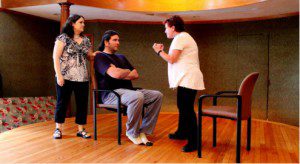
And as psychodrama is an experiential method, to really understand it, one must experience it. Judy and Rebecca facilitated several psychodramas each day so that we all got to experience what it was like to be a protagonist – the person playing the principal role in an enactment, an auxiliary – a person who participates as someone or something in the protagonists life, and an audience member. In the process, I was able to work through some of the emotional blocks that impacted my teaching as well as my work with clients. And by observing other group members work, I was able to connect my own experiences to the larger, human experience and see different ways of responding to shared problems.
Now I’ve come full circle. I am a therapist with a growing private practice. I see individual clients, couples, and groups. And the tools I learned from Rebecca and Judy are the infrastructure of what I do. I use psychodrama to help clients move from stuck to free, from road blocks to building blocks.
**I did see Vanessa several years later. She was a brown belt at the martial arts dojo I attended and seemed to be doing well.
Regina Sewell, PhD/ MEd, LMHC, PCC, CP is certified by the American Board of Examiners as Certified Practitioner of Psychodrama. She is on the faculty on the Hudson Valley Psychodrama Institute. In her private practice, Regina specializes in co-dependency, addictions, LGBT issues and stress management.