
Social Atoms in Substance Abuse Treatment

Social Atoms in Substance Abuse Treatment
by Regina Sewell, LMHC, PCC, CP, PAT
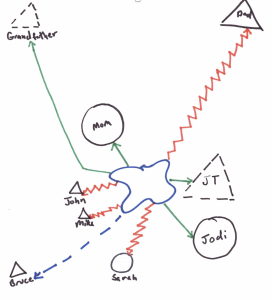
“Show don’t tell” is one of the “golden rules” of writing. It should also be one of the “golden rules” of counseling because telling our clients what to think and what to do doesn’t work. It just creates resistance and gives our clients something to push back against. This is particularly true when it comes to relationships. Telling a client, “I think your best friend – who happens to get high all the time – is a bad influence on you and is likely to lead you to relapse” is rarely met with, “Yeah, good point. I’ll stop hanging out with them,” unless the client is just “yessing” us so that we’ll get off their back. Helping clients make those kinds of connections themselves will at least give them ownership of their knowledge and lays the groundwork for them to make those changes on their own.
Developed by J. L Moreno, the Social Atom is an efficient and easy to use tool in the “show don’t tell” toolbox. The Social Atom is a map of a person’s relationship world. It consists of all the people who are part of a person’s world whether they be alive or dead, friend or enemy. In order to diagram their social atom with pencil and paper, clients put a symbol of themselves at the center and place symbols of other people on the page, near or far, based on their closeness or lack of closeness in life. They can also draw lines to each symbol to indicate positive, negative or neutral feelings. Social Atoms are particularly helpful in substance abuse treatment because they offer a chance for clients to note who on their Social Atom is supportive of recovery, who is likely to lead them to relapse, who is sober and who is using, and who enables their use. The Social Atom can also help clients see the impact of their substance use on relationships because substance abuse often leads to one’s social atom becoming depleted as using becomes more important than people. On the flipside, people pleasers often have overloaded social atoms, indicating that they have a difficult time setting limits and may be challenged to make recovery a priority because others’ needs come first. By creating a visual map of their relational world clients are able to identify for themselves which relationships to hold on to, which they might need to change, and which they might need to let go of in order to get and stay sober.
While the Social Atom is useful when done with pencil and paper, it is even more effective when done in action. By putting the Social Atom into action, clients are able to step into the shoes of each person in their Social Atom and look at themselves through the eyes of the other. Standing in the role of the other allows the client to surmise the essence of that person’s message to them. Back in their own shoes, clients get to hear these messages. This experience cuts through client’s rationalization and denial by bringing clients face to face with the reality of their relationships, the impact that their substance use has on their relationships, and the impact of these relationships have or are likely to have on their sobriety.
The Social Atom also functions as a diagnostic tool. First, as a person’s substance abuse progresses, their social networks often revolve more and more around substance abuse. The extent to which the people on a client’s Social Atom are either drinking and/or using or are enabling their drinking and/or using provides a way to estimate the depth of a client’s substance abuse problem. If a client’s Social Atom is very depleted, and most people on their atom either drink or use or enable their drinking and/or using, this is an indication that they are “in deep.” The Social Atom can also highlight a client’s motivation to change by clarifying a client’s willingness to make changes in their social networks. Finally, the Social Atom provides counselors with a tool that helps them assess the breadth and depth of a client’s support system and indicates what sort of interventions would be most helpful.
To find trainings on using Social Atoms in Substance Use Treatment, check out: https://www.hvpi.net/addictions-track/

Regina Sewell, PhD/ MEd, LMHC, PCC, CP is certified by the American Board of Examiners as Certified Practitioner of Psychodrama. She is on the faculty on the Hudson Valley Psychodrama Institute. In her private practice, Regina specializes in co-dependency, addictions, LGBT issues and stress management.