
Effectiveness of Drama-Based Therapies on Mental Health Outcomes

Effectiveness of Drama-Based Therapies on Mental Health Outcomes: A Systematic Review and Meta-Analysis of Controlled Studies
by Hod Orkibi, Shoshi Keisari, Nisha L. Sajnani, & Martina de Witte

This systematic review and meta-analysis of published randomized controlled trials (RCTs) and controlled clinical trials (CCTs) was conducted to aggregate, examine, and disseminate the current evidence on the effectiveness of drama-based therapies on mental health outcomes, as well as to highlight future directions. We aim to contribute to the mounting empirical evidence suggesting the health benefits of the arts, as recently reported in a scoping review by the World Health Organization (WHO) (Fancourt & Finn,2019) and a compilation of over 80 articles on the psychological and physiological benefits of the arts (Karkou et al., 2022). Similar evidence for the benefits of experiential therapies has also emerged in psychotherapy and cognitive science research (e.g., deWitte et al., 2020;Elliott et al., 2021).
Drama-Based Therapies for Mental Health Outcomes
In this study, we use the term“drama-based therapies” to refer to psychodrama and drama therapy interventions. There is growing documented empirical evidence of the effectiveness of these therapies, as described in detail below. Psychodrama and drama therapy are two organized health professions where credentialed therapists, who have completed extensive academic education and clinical training, employ experiential drama processes and techniques to ameliorate health and well-being within a therapeutic relationship (Landy, 2017;Orkibi, 2020). Both psychodrama and drama therapy are offered to a wide range of clients of all ages, in individual, dyadic, familial, and group formats across a variety of clinical, medical, rehabilitative, educational, and community settings (Orkibi, 2020).
Drama-based therapies can be situated along two different continua (Bailey, 2007). The first continuum ranges from interventions that are more reality-based to those that are fictional. Accordingly, in psychodrama, the story and characters are mostly reality-based, whereas drama therapy approaches often employ the use of fiction and fantasy alongside reality-based techniques. The second continuum ranges from process-oriented to presentational forms.Psychodrama is primarily about process and does not typically move into performance, whereas drama therapy, depending on the needs of the clients, may move from process to presentation, which essentially involves an agreement to move from spontaneous improvisation in the therapy room to rehearsing and then performing a chosen or co-created script for a selected audience to facilitate therapeutic aims (Bailey, 2007; Landy, 2017;Sajnani, 2017).
Thus, in classical psychodrama, a group member (called the protagonist) is chosen to become the focus of the session. The protag-onists play themselves and are encouraged to express their feelings directly and in the first person in the here-and-now, to talk to rather than about other people in their lives, who are usually played by group members (called auxiliary egos) or are represented by an empty chair. Psychodramatists employ a number of intervention techniques. The group members help the protagonist by playing a concrete representation of an absent person, a part of the body, an inner voice, an issue, a spiritual entity, an inanimate object, etc.(for more information see Blatner, 2000).
Conversely, drama therapy encompasses a variety of approaches and theater-based interventions (Jennings & Holmwood, 2016;Johnson & Emunah, 2020) that share an engagement within a dramatic reality consisting of an agreement to engage in pretend play that integrates both reality and imagination which allows individuals and groups to explore subjective experiences in tangible dramatic forms in the here-and-now (Duggan & Grainger, 1997;Johnson & Emunah, 2020;Pendzik, 2006). The therapeutic work that takes place within this dramatic reality can exist at varying degrees of aesthetic distance(Landy, 1983;Scheff, 1981), a key term in drama therapy that refers to a dynamic state in which clients experience a balance between identification and separation from their dramatic work by means of dramatic projection through the use of embodiment, role play, puppets, objects, metaphors, and text. Through aesthetic distance, clients identify with their dramatic work, so they are emotionally close enough to their subjective experience, but are simultaneously also distant enough from their subjective experience to observe the dramatic work and cognitively reflect upon it. Specifically, clients simultaneously play both roles of participant and observer, or movefluidly from one role to another, from remembering (a more passive cognitive process) to reliving in the here-and-now (a more active emotional process), as appropriate (Landy, 1983,1996).
Psychodrama and drama therapy sessions generally have a similar three-part structure composed of the warm-up, main action, and clo-sure (Blatner, 2000;Johnson & Emunah, 2020). The warm-up phase aims to stimulate participants’ spontaneity, playfulness, engagement, and openness to exploration within a safe, trustworthy, and nonjudgmental interpersonal environment by employing drama activities and theater games that are associated with themes relevant to individual clients or to the group as a whole, thus facilitating the transition to the next phase (Dayton, 1990;Jennings, 2017). The main action phase involves the development of improvised dramatic scenes and role-plays to facilitate a deeper experiential exploration of themes. The closure phase involves deroling, which marks the end of the main activity and facilitates a disengagement from the dramatic roles and scenes. This is typically followed by verbal reflections where the participants are invited to share with the group whether and how their lived experience is related to the preceding dramatic work, thus facilitating an opportunity for transition and reintegration back to actual reality.
In sum, as mental health professions, psychodrama and drama therapy are related drama-based therapies where, unlike conventional“talk therapy,”both verbal and nonverbal modes of self-expression are utilized. The embodied nature of the experiential dra-matic activity encourages a shift from reflective exploration in the mental domain to an active and tangible exploration in the here-and-now (Rokotnitz, 2016;Yaniv, 2014).“Both [psychodrama and drama therapy] work through role and story…both are playfulin nature and work within a play space…”(Landy, 2017, p. 37). Both aim to enhance spontaneity, creativity, and flexibility through role play and the dramatic process to ultimately facilitate adaptive personal and interpersonal changes. These fundamental commonalities prompted the inclusion of both psychodrama and drama therapy in this meta-analysis.
Previous Meta-Analyses
Despite the wealth of literature describing clinical work, research on drama-based therapies is relatively scarce compared to other psychotherapies and psychological interventions. Over the years, only a few attempts have been made to systematically review and summarize intervention studies, and meta-analyses are rare in this field. To date, just two meta-analyses have been published, both of which are in psychodrama. The first meta-analysis covered 25 experimentally con-trolled psychodrama studies with both clinical and nonclinical (i.e.,student) participants, published between 1965 and 1999 (Kipper &Ritchie, 2003). Based on the calculation of Cohen’s d effect sizes, the results showed “an overall effect size that points to a large size improvement effect similar to or better than that commonly reported for group psychotherapy in general” (Kipper & Ritchie, 2003,p. 13). The results also indicated that the doubling technique (in which the therapist or a group member expresses something the client is unable to express) and the role reversal technique (in which clients take on the role of another person or entity in their psychodrama) were the most effective. However, a critical examination of this meta-analysis points to several shortcomings. First, the authors specified the “measures of dependent variables” (i.e., the names of the instruments) rather than the independent variables that were measured.Nevertheless, the data hint that the outcomes were heterogeneous, with the most frequent outcomes being attitude change and conflict resolution. Moreover, the authors did not clearly indicate whether the review method was registered in a protocol prior to the review. They also did not provide any keywords and/or full details on their search strategy and did not include a rationale for including bothRCTs and CCTs. Furthermore, whereas study selection was per-formed in duplicate, there is no information on the data extraction process and no procedure for assessing quality or risk of bias in the included studies.
The most recent meta-analysis was conducted by Q. Wang et al.(2020) who examined the effects of psychodrama on Chinese participants’ depression and anxiety, in nine studies (four RCTs, threeCCTs, and two unspecified designs; L. Li & Q. Wang, personal communication, August 22, 2022). The results showed a large overall effect for depression and a medium-to-large overall effect for anxiety, which varied as a function of the measurement scale used. However, four of the studies examined a Chinese adaptation called“scene psychodrama”that accommodates the Chinese culture and national traits. This version is educational and focuses on general social themes and social roles, as in sociodrama (Sternberg & Garcia, 2000), unlike Western psychodrama that centers on personal and interpersonal issues in a direct manner. TheChinese version not only involves psychodrama but also music, dance, painting, and Chinese calligraphy. A subgroup analysis indicated that“classical”(i.e., Western) psychodrama was more effective than scene psychodrama for anxiety symptoms in this sample. Given the clinical differences between the two types of psychodrama, it is difficult to draw unequivocal inferences about the overall effect of psychodrama in this review. In addition, the studies only involved Chinese participants, which limit the generalizability of the findings. Furthermore, the authors did not state a rationale for including both RCTs and CCTs in their review.Despite these shortcomings, this meta-analysis mostly followed the guidelines of the Preferred Reporting Items for SystematicReviews and Meta-Analyses (PRISMA) and for presenting the flow of information through the different phases of the systematic review using the recommended flow diagram. In addition, the authors preregistered their review protocol in PROSPERO, specified keywords and search terms, used three researchers for study selection and two for data extraction, assessed heterogeneity and risk of bias, and reported effect sizes. In light of these two meta-analyses, the design of the present study attempted to overcome the above-mentioned drawbacks, as described below.
Previous Reviews of Psychodrama
In addition to these two meta-analyses, a few reviews have also summarized the evidence base in psychodrama, where all refer to the statistical significance reported in each study rather than to effect sizes. Kipper (1978)published the first review article on the effectiveness of psychodrama, which covered 14 studies of which12 were controlled studies that compared psychodrama to a control group. Overall, this review reported a positive impact of psycho-drama on behavioral retraining and outcomes related to mental ill-ness. In the second review, Kellermann (1987a) included 23controlled studies and concluded that psychodrama is a valid alternative to other treatments, mainly in promoting behavior change, but not in changing personality traits. Kellermann also noted the scant use of tests designed by the originator of psycho-drama, J. L. Moreno, or his students to measure outcomes associated with his theory, such as spontaneity and creativity tests, role play tests, and other experiential tests. In a later review by Rawlinson(2000), the design of the 41 studies was not always clear; it appears to have included two studies with a single-group pretest–posttest design and two qualitative studies. Nevertheless, the author concluded that 34 of the studies reported positive effects of psychodrama on mental health outcomes, including self-esteem, behavioral change, empathy, and social relationships (Rawlinson, 2000).
The largest review to date was conducted by Wieser (2007) who included 52 studies, consisting of eight RCTs, 14 CCTs, and 30 naturalistic studies in routine practice without any control group and single case studies. After grouping all the study outcomes according to the categories defined in the WHO’s International Classification of Diseases-10 (ICD-10), and based on the statistical significance reported in each study, Wieser concluded that psychodrama is most effective for treating the ICD-10 category of“neurotic, stress-related and psychosomatic disorders.”More than a decade later, a systematic review of eight CCTs examined the effect of psycho-drama on the health of adolescent girls (Daemi & VaseghRahimparvar, 2018). The results showed that psychodrama improved the mental health of adolescent girls, including internalizing (e.g., anxiety and depression) and externalizing (e.g., oppositional defiant disorder, hyperactivity) symptoms, among others.
An integrative approach to a systematic review was undertaken by Orkibi and Feniger-Schaal (2019)that included 31 studies, of which four were qualitative, seven had a mixed methods design, and 20were quantitative (with six single-group pretest–posttest studies, twoCCTs, and 12 RCTs). Taken together, these studies examined more than 20 different outcomes, where the most frequent, in descending order, were behavioral problems, anxiety, depression, and quality of life. The findings suggested that psychodrama intervention research has followed an upward trajectory, with promising positive results across research designs and methodologies. Finally, in the latest systematic review, López-González et al. (2021)included 14 RCTs an done CCT. The authors concluded that the heterogeneity of outcomes suggests that psychodrama contributes to a wide range of outcomes, including mental illness symptoms (illness reduction) as well as subjective well-being and quality of life (health promotion).
Overall, these seven reviews suggest that psychodrama can have a beneficial effect on a wide range of outcomes and diverse clients. However, only three of these reviews (Daemi & VaseghRahimparvar, 2018;López-González et al., 2021;Orkibi &Feniger-Schaal, 2019) specified their search process according to the PRISMA guidelines and presented the flow of information through the different phases of a systematic review using the recommended flow diagram. Quality or risk of bias assessment was only conducted in two reviews (López-González et al., 2021;Orkibi &Feniger-Schaal, 2019) and the use of a preregistered protocol (i.e.,PROSPERO) was only reported in one review (López-González et al., 2021).
Previous Reviews of Drama Therapy
To date, five reviews have been published on the effectiveness of drama therapy. Yotis (2006)published a narrative review of seven quantitative studies (unspecified designs) and over 10 qualitative and theater-based studies (mostly case studies) on living with schizophrenia. The author cautioned that samples are often too small, which precludes the use of rigorous statistical tests as well as generalizability, and that most drama therapy researchers use self-devised rather than standardized measures. Overall, this review makes it difficult to determine the robustness of the findings with this population. Similarly, in a Cochrane review of five RCTs that compared drama therapy interventions to standard inpatient care for schizophrenia or schizophrenia-like illnesses, the authors stated that“due to poor reporting, very little data from the five studies could be used and there were no conclusive findings about the harms or benefits of drama therapy”(Ruddy & Dent-Brown, 2007, p. 2). Effect sizes were not reported.
Moreover, another systematic review of only three quantitative studies examined the effectiveness of drama therapy (single-group pretest–posttest design), theater-based intervention (single-group pretest–posttest design), and psychodrama (RCT) on substance use recovery (Leather & Kewley, 2019). While the drama therapy study reported no significant results, the psychodrama study only showed a significant increase in quality of life. In the theater-based intervention, social and occupational engagement improved significantly post intervention and at the 6-week follow-up, but started to decline after this point. The authors reported the effect size for only one study and concluded that the small sample sizes and methodological shortcomings“hamper the already scarce published research around this topic”(p. 555). Taken together, the inclusion of both psychodrama and drama therapy is in line with our assertion that these two methods lie on a continuum of drama-based therapies.
Feniger-Schaal and Orkibi (2020)conducted an integrative systematic review that included 24 studies with diverse client groups, approaches, and methodologies composed of seven single-group pre-test–posttest designs, six qualitative studies and case studies, fiveCCTs, four RCTs, and two mixed methods studies. The authors did not report the studies’ effect sizes but concluded that drama therapy offers effective treatment for various populations. The largest number of studies dealt with adults and children with developmental disabilities, cognitive impairments, or both. The conclusion to this review emphasized the need for improving methodology, reporting transparency, and increasing specificity in terms of treatment components.Another integrative systematic review focused on drama therapy for children and adolescents on the autism spectrum (Bololia et al.,2022). This review included six qualitative studies, two quantitative studies (single-group pretest–posttest designs with unreported effect sizes), and one mixed methods study. The authors found benefits for emotional, psychological, and social development in this population. Yet another systematic review examined drama therapy for children and adolescents with psychosocial problems (Berghs et al.,2022). The nine studies included in the review consisted of fourRCTs, three CCTs, and three studies with a single group pre–post design. Effect sizes were only reported in three studies. The authors reported positive effects for several outcomes such as overall psycho-social problems, internalizing and externalizing problems, and social functioning. However, in two studies the intervention integrated drama therapy with other therapy approaches, and in one other study the intervention was not explicitly identified as drama therapy, which somewhat limits the conclusion regarding the specific effect of drama therapy on this population. Finally, two additional reviews were excluded from this overview because they did not focus directly on evaluating relevant empirical evidence. One did not include any quantitative studies (Bourne et al., 2018), and the other probed prominent outcome“themes”in drama therapy effectiveness research across methodologies (Armstrong et al., 2019).
Thus overall, the evidence for the effectiveness of drama therapy is mounting, with a clear prevalence of qualitative designs and an under representation of robust RCTs. Five reviews used the recommended PRISMA guidelines and flow diagram to clearly convey their search process (Berghs et al., 2022;Bololia et al., 2022;Bourne et al., 2018;Feniger-Schaal & Orkibi, 2020;Leather &Kewley, 2019). Quality or risk of bias assessments was conducted in five reviews (Berghs et al., 2022;Bololia et al., 2022;Feniger-Schaal & Orkibi, 2020;Leather & Kewley, 2019;Ruddy & Dent-Brown, 2007). The use of a preregistered protocol was only reported in three reviews (Bourne et al., 2018;Leather & Kewley, 2019;Ruddy & Dent-Brown, 2007).
The Present Study
The above overview of previous systematic reviews and meta-analyses point out their shortcomings. Specifically, previous efforts(a) included studies with research designs that varied in terms of methods and rigor, (b) rarely reported adherence to or deviation from a preregistered protocol, (c) seldom assessed the quality or risk of bias of the studies, and (d) none conducted moderator analyses of the within and between study differences on the outcomes.These shortcomings underscore the need for a systematic review and meta-analysis of the effectiveness of psychodrama and drama therapy interventions with a proper procedure and a focus on the most rigorous research designs: RCTs and CCTs. We includedCCTs because a review that is restricted to RCTs would provide an incomplete summary of the current evidence on the effects of drama-based therapies.
The aims of this systematic review and meta-analysis were to (a)aggregate and synthesize the evidence on drama-based therapies,(b) assess the strength of the effects of drama-based therapies on mental health outcomes of illness reduction (e.g., depression) and health promotion (e.g., psychological well-being), and (c) examine which outcome, study, sample, or intervention characteristics moderated the strength of the effect on the outcomes. Beyond the weight of the conclusions, which may facilitate informed decision-making by healthcare providers and policymakers, the results of the present study may also serve to highlight the existing strengths and weak-nesses in the current scientific field and inspire a careful re-examination of methodology and theory (Carter et al., 2019;Hagger et al., 2016).
Method
Inclusion Criteria
For the current meta-analysis, multiple inclusion criteria we reapplied. First, we only included RCTs and CCTs that examined the effect of drama-based therapies (psychodrama or drama therapy) onmental health outcomes (i.e., feelings, thoughts, behaviors) in which the interventions were operationalized as therapy. Second, only journal articles published in English were included. We excluded other publication types, such as conference abstracts, poster presentations, dissertations and theses, and theoretical and review papers.Third, we excluded studies that did not examine mental health out-comes, such as outcome measures of specific physiological variables(e.g., pain, sleep quality, smoking cessation) and strictly cognitive variables (e.g., memory test, information processing).
Selection of the Studies
In collaboration with an independent medical librarian, multiple systematic searches were carried out. Librarian engagement is significantly associated with a higher quality of reported search strategies (Rethlefsen et al., 2015). A computer-based search of seven psycho-logical and medical electronic literature databases was conducted, including Cochrane Library, Web of Science, Embase, WileyOnline Library, PubMed, PsycINFO, and Scopus. All RCTs andCCTs available until January 5, 2021, that met the inclusion criteria were included in this systematic review and meta-analysis.
The search string comprised two elements: a drama intervention element and a study design element. For the drama intervention element, the following keywords were used:“psychodrama”or“drama therapy.”Concerning the study design element, the following keywords were used:“randomized controlled trial,”“randomised con-trolled trial,”“clinical controlled trial,”“randomised,”“randomized,”“RCT,”“CCT,”“quasi experimental,”or“controlled.”In addition, the reference lists of review and meta-analytic articles on the effectsof psychodrama or drama therapy interventions were inspected for qualifying studies (e.g.,Bololia et al., 2022;Feniger-Schaal &Orkibi, 2020;Orkibi & Feniger-Schaal, 2019). The search protocol for this meta-analysis was registered in the international prospective register of systematic reviews (PROSPERO ID: CRD42020160715).
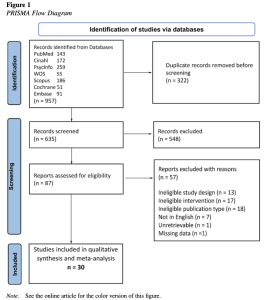
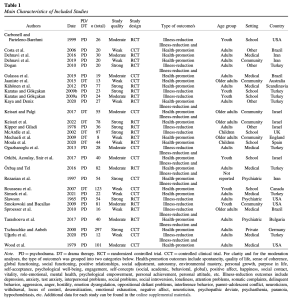
After duplicates were removed, the initial search resulted in635 individual studies. The first selection on title and abstract resulted in 87 individual studies that were full-text screened based on the inclusion criteria. Finally, 30 studies met all the inclusion criteria (seeFigure 1). The selection process was conducted by two different authors, who selected the studies independently of each other. To resolve selection conflicts, a third author was involved in the final decision making. An overview of the included studies and their main characteristics can be found inTable 1. Additional data for each study can be found in the online supplemental materials.
Coding and Moderators
The first and the second authors coded the studies using a coding sheet according to the recommendations by Lipsey and Wilson(2001). The independent variable was drama-based therapies, including psychodrama or drama therapy. Mental health outcomes were considered the dependent variable. Multiple variables with a potential moderating effect on the relationship between drama-based therapies and mental health outcomes were identified, partly based on previous research (de Witte et al., 2022;Orkibi & Feniger-Schaal, 2019) and on the research question underpinning this meta-analysis. These moderating variables covered outcome, study, sample, and intervention characteristics.
Mental health outcomes were coded as psychological outcomes when they referred to feelings or thoughts and as behavioral outcomes when they referred to observable actions (e.g.,Utley et al., 2022). We coded whether the outcomes were assessed by self-report or observational questionnaires. Evidence suggests that observational measures(also known as proxy reports) may be less accurate and less sensitive than self-report measures (de Witte, Kooijmans, et al., 2021;Scott & Havercamp, 2018). In the current meta-analysis, 93% of the studies applied self-report measures as compared to observational measures.We also coded whether the outcome was related to illness reduction or whether the outcome was specifically aimed at improving mental health or health promotion since there has been a prolonged debate on the distinction between mental health and mental illness (Huberet al., 2011). In terms of study characteristics, we coded the study design, the type of control condition, and the study quality. The study design was coded as RCT when participants were randomly allocated to treatment conditions (e.g., computer-generated randomization lists), and as a CCT design when authors did not explicitly mention randomization, or in the case of quasi-randomized studies. We also coded the type of control condition because different control conditions can yield different effect sizes (Finney, 2000;Karlsson &Bergmark, 2015). We coded care as usual(CAU) when no other intervention was provided apart from the participants’ routine mental health care, waiting list when no care or intervention was provided, or other intervention when another treatment was delivered, such as ver-bal therapy or pharmacotherapy. To assess the risk of bias, the quality of the study was coded as strong, moderate, or weak based on theQuality Assessment Tool for Quantitative Studies (Effective PublicHealth Practice Project, 2009), which provides a structured and comprehensive assessment (Armijo-Olivo et al., 2012). This instrument has high content and construct validity (Jackson et al., 2005;Thomas et al., 2004) and has been used in recent multilevel meta-analyses (Beek et al., 2018;de Witte et al., 2020). Studies ranked a slow in quality negatively affect the internal validity (i.e., causal conclusion), which can lead to a biased estimation of the overall effect estimate (Zeng et al., 2015).
Regarding the sample characteristics, we coded whether the study was conducted in a clinical setting(e.g., hospitals, health organizations, clinics), in communities/schools, or in private practices. The average age of the participants was also coded, resulting in three different age categories:older adults(age.60),adults, and children/youth, since research has shown several differences in mental health outcomes between these age groups (Steen & Thomas, 2015).
In addition, five intervention characteristics were coded, since a previous review showed their relevance for the creative arts therapies (de Witte, Orkibi, et al., 2021). We coded whether the study examined the effect of psychodrama interventions or drama therapy, given the previously mentioned similarities and differences between the two approaches (Bailey, 2007;Landy, 2017). We also coded whether the therapist delivering the therapy was specifically trained in psychodrama or drama therapy, or whether this was not clearly reportedin the study, because therapists’ competence can be consequential to clinical outcomes (Haug et al., 2016). The number of sessions delivered was also coded, since previous studies have shown that the number of sessions is positively correlated with various mental health outcomes (Cassileth et al., 2003;de Witte et al., 2022;Gold et al., 2009). The frequency per week and length of the therapy sessions delivered were also coded.
Calculation and Analyses
The methodology applied here is consistent with several previous three-level meta-analyses such as those that have examined the effects of music interventions on stress-related outcomes (de Witteet al., 2020,2022), the effects of physical activity interventions on psychosocial outcomes in adolescents (Spruit et al., 2016), and the study by Roest et al. (2023)on the therapeutic alliance in child and adolescent psychotherapy.The effect sizes were transformed into Cohen’s d by usingWilson’s online calculator (D. B. Wilson, 2022) and formulas in Lipsey and Wilson (2001). Negative effect sizes indicate that a given drama-based therapy had a negative effect on mental health outcomes. Most d-values were calculated based on reported means and standard deviations. To correct for pretreatment differences, pre-test effects were subtracted from posttest effects. For the categorical moderators, dichotomous dummy variables were created. The continuous moderators (session length, frequency, and number) were centered on their means. Two outliers in effect sizes were identified using box plots (Tabachnick & Fidell, 2013), and were winsorized (i.e., replaced by the highest or lowest acceptable score falling within the normal range). Standard errors were estimated using the formulas by Lipsey and Wilson (2001).
In some studies, more than one effect size could be calculated, since most of them reported multiple mental health outcome vari-ables, using several measurement instruments. Effect sizes from the same study tended to be more alike than effect sizes fromother studies. The assumption of independent effect sizes underlying traditional meta-analytic methods was therefore violated (Hox et al.,2017;Lipsey & Wilson, 2001). Thus, we applied a multilevel approach to the meta-analysis to account for the interdependency of effect sizes (Assink et al., 2015;Cheung, 2014;de Witte et al.,2020;Spruit et al., 2016).
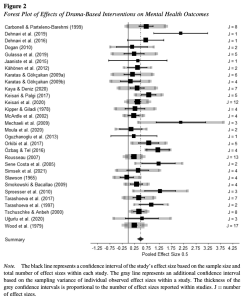
A three-level meta-analytic model was used to calculate the combined effect sizes and run the moderator analyses. Three sources of variance were modeled, including the sampling variance for eacheffect size (level one), the variance between effect sizes within studies (level two), and the variance between studies (level three)(Assink & Wibbelink, 2016). The meta-analysis was conducted inR (Version 4.1.2) with the Metafor package, employing a multilevel random effects model (Houben et al., 2015;Viechtbauer, 2010).This model is often used for multilevel meta-analyses and, in general, is superior to the fixed-effects approaches used in traditional meta-analyses (Van Den Noortgate & Onghena, 2003). We used likelihood-ratio tests to compare the deviance scores of the full model and the models without variance parameters on levels two and three to determine whether the level two and three variances were significant, which would indicate the heterogeneity of effect sizes. A heterogeneous effect size distribution shows that the effect sizes cannot be treated as estimates of a common overall effect size.In that case, we conducted moderator analyses, because the differences across effect sizes could be explained by outcome type, study design, sample, and/or intervention characteristics.A forest plot was generated following the recommendations by Fernández-Castilla et al. (2020)and the recently published meta-analysis by Roest et al. (2023), for specific use in multilevel meta-analyses. This modified forest plot contains additional confidence intervals based on the sample variance of both individual observed effect sizes as well as the total number of effect sizes within studies, and thus provides information on the variability in effect sizes between studies and the relative contribution to the overall effect size estimate.
Publication Bias
A common problem in conducting a meta-analysis known as the file drawer problem (Rosenthal, 1995) is that studies with nonsignificant or negative results are less likely to be published than studies with positive and significant results. Therefore, the studies included in a meta-analysis are often not an exhaustive representation of all possible studies conducted.To test for the presence of publication bias in the current meta-analysis, we applied three methods. First, Egger regression (Egger et al., 1997) was used to test the degree of funnel plot asymmetry as measured by the intercept from regression of standard normal deviates(effect size divided by its standard error) against the estimate’s precision (the inverse of the standard error). Funnel plot asymmetry is indicated by a significant Egger regression test. In the present meta-analysis, however, an adapted three-level version of Egger’s test was used in which the standard error of the effect size was tested asa moderator in the regression model (Fernández-Castilla et al., 2021).The adapted Egger’s test accounts for the dependency of effect sizes.Second, to align with the new standards of addressing publication bias in multilevel meta-analyses, we also used an extension of the funnel plot test for use in three-level meta-analyses (seeFernández-Castillaet al., 2021;Roest et al., 2023). Following the guidelines developed by Fernández-Castilla et al. (2020)on the use of funnel plots in three-level meta-analyses, both the funnel plot of all effect sizes and the plot of study effects are presented.
Finally, a trim-and-fill procedure was performed (Duval & Tweedie, 2000a,2000b). We tested whether effect sizes were missing on the left and right sides of the distribution. Publication bias would only be likely to occur in case of nonsignificant or unfavorable (i.e.,negative) results, resulting in left-sided funnel plot asymmetry.Right-sided funnel plot asymmetry is indicative of a selection bias.
Results
Overall Effect of Drama-Based Therapies on MentalHealth Outcomes
The present meta-analysis on the effects of drama-based therapies on both psychological and behavioral mental health outcomes included 30 independent studies (s), reporting on 144 effect sizes(k), with a total ofN=1,567 participants.Table 1presents an over-view of the main characteristics of the included studies.Table 2 shows the overall effect of drama-based therapies on mental health outcomes. Overall, we found a significant medium effect (d=.501,[.36, .64]) of drama-based therapies on mental health outcomes in clinical settings, schools and communities, and in private practices.A forest plot of the three-level meta-analysis is presented in Figure 2.
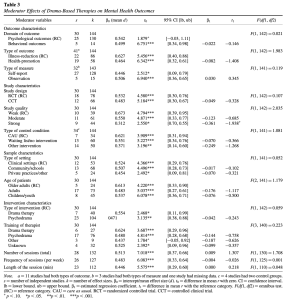
The likelihood ratio test showed that significant variance was pre-sent at the between-study level (Level 3) and the within-study level(Level 2). We, therefore, conducted moderator analyses on the typeof outcome as well as study and intervention characteristics to examine the effect of drama-based therapies on mental health outcomes.The moderator effects are presented in Table 3.
Results of the Moderator Analyses of Drama-Based Therapies on Mental Health Outcomes
The characteristics of the outcome, study, sample, and intervention did not influence the effects of drama-based interventions on mental health outcomes. Although differences between the moderator categories were not statistically significant, which in several cases may have been due to the small number of studies in certain categories of moderating variables (seeTable 3), further studies are necessary to estimate these differences with more precision. Therefore, we present the results for each moderator and its categories.
Outcome Characteristics
None of the outcome characteristics showed a moderating effect.With respect to the domain of outcome, the category of studies examining psychological outcomes (d=.542, [−0.03, 1.11]) did not yield a significant effect. Studies examining behavioral out-comes (d=.499, [.34, 0.98]) showed a medium effect. The use of self-report measures (d=.446, [.09, .79]) and observational measures (d=.506, [.36, .65]) both yielded a medium effect. Despite the absence of moderation effects, the analyses showed that the effect size of studies focusing on outcomes related to illness reduction (d=.627, [.40, .86]) was larger than those with outcomes related to health promotion (d=.464, [.32, .61]).
Study Characteristics
Study characteristics related to the research methodology did not show significant moderating effects on mental health outcomes.Nevertheless, the effect sizes of the different moderator categories are noteworthy. RCTs (d=.532, [.30, .76]) yielded slightly stronger effects compared to CCTs (d=.483, [.30, .67]). With respect to the type of control condition, studies with CAU showed a larger effect size (d=.621, [.31, .94]) than studies with waiting list controls(d=.551, [.34, .76]) or another intervention (d=.371, [.14, .60]).Low-quality studies (d=.673, [.39, .95]) yielded larger effects than studies with a moderate (d=.550, [.33, .77]) or strong(d=.371, [.70, .55]) study quality.
Intervention Characteristics
Intervention characteristics did not show significant moderating effects on mental health outcomes. However, it is noteworthy that the analysis showed slightly larger effects for studies with drama therapy interventions (d=.554, [.11, .99]) than studies with psychodrama interventions (d=.471, [.38, .88]). Studies in which the intervention was delivered by a drama therapist (d=.624, [.29, .96]) did show a larger effect than studies in which the intervention was delivered by a psychodramatist (d=.480, [.28, .68]), or studies in which the therapist’s training was not reported (d=.525, [.09, .96]). Finally, the effect of both the total number (d=.513, [.37, .66]) and length(d=.446, [.29, .60]) of the sessions, as well as the frequency of sessions per week (d=.483, [.33, .64]), did not significantly influence the overall effect of drama-based therapies on mental health outcomes.
Sample Characteristics
Although no significant difference was found between the age groups, studies with older adults (d=.613, [.33, .90]) showed a larger effect than studies with children (d=537, [.36, .71]) or adults (d=483, [.27, .61]). Studies conducted in clinical settings did show a medium effect (d=.524, [.29, .76]), as within community/school

settings (d=.507, [.28, .73]), and in private practices (d=.454,[.09, .81]). Note that due to the vast amount of missing data regard-ing gender, socioeconomic status, or ethnicity, these variables could not be used as moderators.
Publication Bias
To test the degree of funnel plot asymmetry, we applied an adapted version of Egger regression (Egger et al., 1997) and the funnel plot test adapted from Fernández-Castilla et al. (2021). In addition, we conducted trim-and-fill analyses (Duval & Tweedie, 2000a, 2000b;Fernández-Castilla et al., 2021).Results of the Egger test revealed possible publication bias(B=1.66,z=3.21,p=.0013). However, the funnel plot test revealed no indications of publication bias, because no effect sizes were missing on the left side of the funnel plots. Notably, visual inspection of the funnel plot of individual effect sizes suggested that small (underpowered) studies with null or negative effects may not have been published, but this did not appear to be the case when looking at larger studies or when inspecting the plot of the effect size distribution at the study level. For the present meta-analysis, the funnel plot of all ESs (Figure B1 in the online supplemental materials) and the funnel plot of study effects (Figure B2 in the online supplemental materials)can be found in Appendix B in the online supplemental materials.The results of the trim-and-fill procedure indicated that effect sizes were not missing on the left side of the plot, but had to be imputed on the right side of the plot, indicating that the overall effect of drama-based therapies on mental health outcomes did not need to be adjusted down-wards. Thus, the publication bias analyses showed equivocal results.It therefore cannot be ruled out that the magnitude of the meta-analytic overall effect might represent some overestimation of the overall true effect size, although an underestimation of the overall true effect size seems more likely given the indications of selection bias.
Discussion
This systematic review and meta-analysis of published RCTs andCCTs was conducted to aggregate, examine, and disseminate the
current evidence on the effectiveness of drama-based therapies on mental health outcomes, as well as to highlight future directions.
Overall Effects
A multilevel meta-analysis was performed on 30 controlled studies, 144 effect sizes, and 1,567 participants. Overall, we found a significant medium effect (d=.501, [.36, .64]) of drama-based therapies on mental health outcomes, indicating that participants who received group psychodrama or drama therapy interventions benefited more than those in the control conditions receiving no care/intervention (such as waiting list controls), CAU, or another therapeutic intervention. The present study charts the growth in con-trolled studies examining the effects of drama-based therapies on mental health outcomes, which should lead to formulating more valid conclusions about the effects of nonpharmaceutical and experiential-based therapies on mental health. The findings of the present meta-analysis are consistent with previous systematic reviews on the effects of psychodrama and drama therapy on mental health outcomes (e.g.,Feniger-Schaal & Orkibi, 2020;Orkibi & Feniger-Schaal, 2019). Similar overall effects have been found in previous reviews of other creative arts therapies (e.g.,de Witte etal., 2020, 2022;Karkou et al., 2019;Koch et al., 2019) as well as other psychotherapies (e.g.,g=0.49–0.62 by Weitz et al., 2018).
However, the effect of the current meta-analysis is smaller than that of the two previous meta-analyses of psychodrama interventions, which reported relatively larger effects on mental health out-comes (d=0.95, byKipper & Ritchie, 2003;d=0.75–2.04 byQ. Wang et al., 2020). The difference in effect magnitude may be due to the fact thatKipper and Ritchie (2003)did not assess risk of bias in individual studies; hence the influence of weak study designs is unknown, and the overall effect should be considered carefully (Liebherz et al., 2016). Another explanation has to do with the fact that 76% of the studies included inKipper andRitchie (2003)examined the effect of a single psychodrama technique, which may provide a higher degree of experimental precision and thus potentially generate larger effects than more naturalistic investigations of a looser psychodrama process (Blatner, 2000).Direct comparison of our results to those ofQ. Wang et al. (2020)is likely to be unsound because 44% of their studies examined an educational adaptation of psychodrama that integrated other art forms and fit the description of sociodrama, which focuses on general social themes and social roles (Sternberg & Garcia, 2000), unlike classical Western psychodrama that focuses directly on a client’s personal and interpersonal problems (Moreno, 1946).
Because the studies included in our meta-analysis all followed a format for group interventions, it seems justified to suggest that healthcare providers should consider, as a matter of policy, whether drama-based therapies are offered in group or individual formats.This may help optimize the allocation of health system resources and unblock today’s long waiting lists (Aguilera-Martín et al.,2022;Uttley et al., 2015).
Effects of Moderating Variables
Contrary to our expectations, none of the moderating variables significantly influenced the effects of drama-based therapies on mental health outcomes. However, some noteworthy differences in effect sizes were found in our moderator analyses that did not reach the conventional level of significance. We also noted some moderators with little or no difference in individual categories that deserve to be high-lighted since they have implications or future research.
First, with respect to study design, the somewhat stronger effects of drama-based therapies in RCTs compared to CCTs is surprising, since RCTs may better exclude alternative explanations for established intervention effects than nonrandomized designs and are therefore considered more rigorous. Selection bias in nonrandom-ized studies (i.e., when participants self-select into the study groups)can lead to overestimations of treatment effects (Page et al., 2018)and may thus influence the overall effect size of a meta-analysis.Therefore, the moderator analyses of the present study were expected to indicate that studies with an RCT design had a smaller effect size.Moreover, a similar multilevel meta-analysis (de Witte et al., 2022)found that study design was a significant moderator of the overall effect; in other words, that RCTs had less impact on the overall effect. Notwithstanding the fact that we performed moderator analyses to gain insights into the impact of the nonrandomized study designs, the inclusion of RCTs is still the gold standard for conduct-ing meta-analyses. Therefore, despite the potential obstacles to properly conducting RCTs (for an overview see Djurisic et al., 2017),researchers should still strive to align with RCT standards in future studies because they are the most rigorous way to assess causality between treatment and its outcomes. On the other hand, the inclusion of quasi-experimental studies in meta-analyses, which are usually conducted under clinically representative conditions, do not only increase statistical power but also may substantially increase the external validity of meta-analytic findings (Shadish et al., 2008).
Second, the moderator study quality did also not reach the conventional level of statistical significance, indicating that weak-quality studies did not have a significant effect on the overall effect. Yet, only one-third of the studies could be assessed as strong because most of the studies included in this meta-analysis lacked a clear mask-ing (i.e., blinding) procedure for participants, similar to other therapy studies (Day & Altman, 2000;de Witte et al., 2022;Tambling, 2012).
Third, despite the fact that we found no significant moderating effect on the type of control condition, it is worth noting that lower effects were reported in studies in which controls received another intervention, such as verbal psychotherapy interventions.Studies in which controls received a different intervention compared to those who received CAU or were wait-listed showed generally lower effects, which is in line with previous studies in psychiatric populations (Arrindell, 2001;de Witte et al., 2022;Haeyen et al.,2018b). Moreover, the individual studies included did not always clearly define what the control condition entailed. Therefore, future studies should report more precisely on the design of control conditions to better examine the superiority, noninferiority, or equivalence between different treatment conditions (B. Wang et al., 2017).
Finally, there was no significant difference between psychodrama and drama therapy interventions; in other words, the overall effect of drama-based therapies on mental health outcomes was not influenced by the type of intervention/approach. Most of the included studies, however, provided scant information on the specific content of the psychodrama or drama therapy intervention, which curtailed our ability to further examine intervention characteristics. We, there-fore, urge researchers not only to describe the treatment protocol in greater detail in the future, but also to use the available guidelines for intervention descriptions, such as theTemplate for InterventionDescription and Replication(TIDieR) which is designed to improve the completeness of reporting and the replicability of interventions(Hoffmann et al., 2014). Relatedly, information on any other treatment that the psychodrama or drama therapy participants received during the intervention was missing in almost all studies, which makes it impossible to account for potential confounding variables across studies. This still leaves unanswered the question of whether drama-based therapies can be regarded as primary or adjunct (complementary) therapies (Cashell & Miner, 1983). In addition, researchers should implement and report all strategies used to ensure treatment implementation fidelity. This includes (a) the extent to which a therapist delivers the intervention with adequate adherence to the manual and/or intended treatment modality and its theory-specified techniques or methods, and (b) the competence or skillful-ness with which these techniques or methods are implemented(Hildebrand et al., 2012). A treatment fidelity scale for drama-based therapies is currently under development.
In terms of outcome characteristics, half of the included studies focused specifically on health promotion outcomes, with similar effects to those aimed at illness reduction. This fits the general assumption that mental health as a whole consists of both the absence of mental illness symptoms and the presence of positive mental health indicators (Keyes, 2013). In the last decade, there has been a shift in mental health care from focusing on symptom reduction to the improvement of positive mental health (Haeyen et al., 2018a;Orkibi, 2019;World Health Organization, 2018). Thisis consistent with the mounting evidence for the effectiveness of strength-based and positive psychological interventions (Bolier etal., 2013;Carr et al., 2021;Snyder et al., 2021), such as the positive psychodrama approach where positive psychological interventions are implemented experientially in action rather than only talking or writing (Orkibi, 2019).
Therapeutic Factors in Drama-Based Therapies
We did not find any significant moderating effects of the selected intervention characteristics. Moreover, none of the studies included in our meta-analysis performed mediation analyses. However, research into the therapeutic factors that contribute to positive effects is crucial for progress in the field (de Witte, Orkibi, et al., 2021). Given the increasing evidence that drama-based therapies have a positive impact on mental health outcomes, the field has gradually expanded its inquiries from whether psychodrama and drama therapy work, to how and why they work. Kellermann (1987b,pp. 410–411) presented an early conceptualization of six broad categories of therapeutic factors in group psychodrama: emotional abreaction/release, cognitive insight, behavioral learning, interpersonal relationship, nonspecific healing aids, and the therapist’s qualities. However, these categories are generic in the sense that they can be applied to many other treatment approaches since they do not point to specific drama-based therapeutic factors.
In drama therapy,Jones (1996,2007)conceptualized nine core change processes that are shared by all drama therapy approaches:dramatic projection, drama therapeutic empathy and distancing, role playing and personification, interactive audience and witness-ing, dramatic embodiment, playing, life–drama connection, transformation, and therapeutic performance. Through a Delphi study, Frydman et al. (2022)further refined this list into seven core processes including active witnessing, distancing, dramatic play, dramatic projection, embodiment, engagement in dramatic reality, and multidimensional relationship.Cassidy et al. (2014,2017)described six meta-processes in drama therapy including establish-ing safety, offering control and choice, play, working along side the client, working in the here-and-now, and being actively involved in making abstract experiences visible and physical. However, these meta-processes also characterize other experiential psychotherapy approaches (e.g., music therapy, emotion-focused therapy, Gestalt;see alsoElliott et al., 2021), and therefore require further articulation to better convey their specificity in drama-based therapies.
To this end, in a recent scoping review on therapeutic factors in the broader creative arts therapies (CATs)field, the authors differentiated between common factors that are shared across all psychotherapy approaches, joint factors that are shared across the CATs, and specific factors in each CATs discipline (de Witte et al., 2021). Specificity is important in order to formulate a theory of change that is grounded in the change factors that are specific to a given treatment approach, such as psychodrama and drama therapy. Emerging research suggests that the specific therapeutic factors in drama-based therapies include active engagement, which refers to the extent to which a client activelyengages with and is immersed in the dramatic activities in a session(e.g., role playing, verbal and physical expressions, creative and pro-jective work, etc.;Cassidy et al., 2017; Orkibi et al., 2017);role-reconstruction and expansion, which refers to the extent towhich clients can explore various roles as a tangible representation of themselves (Bucut ̧a ̆et al., 2018;Keisari, 2021;Ramsden &Landy, 2020); two observable change factors that enableaesthetic dis-tance(Cassidy et al., 2014,2017) including a dramatic projection that refers to the externalization and projection of inner conflicts onto dra-matic material, anddramatic embodiment that refers to physical expression in dramatic enactments (Armstrong et al., 2016).Psychodramatists and drama therapists also employ concretization, the process of shaping abstract content or experiences into a tangible and visible dramatic form, which enhances understanding by externalizing the client’s problem(Johnson, 1985;Kushnir & Orkibi, 2021).Dramatic reality in drama-based therapies enables fluidity(i.e., a flowing movement) between roles, times, and locations as well as condensation which, according to Freud’s dream theory (1997), broadly refers to the fusion of different elements into one, such as simultaneously including both the past and the future in the here-and-now or the fusion of two places or people into one scene or character (see Kowalsky et al., 2022).
One of the biggest challenges in drama-based change process research, which examines the therapeutic factors in the treatment process, is the lack of clear operationalization of drama-based therapeutic factors and the absence of tools to quantitatively measure them. One of the crucial next steps is to develop a cogent theory of change for psychodrama and drama therapy, followed by the development of psychometrically sound self-report scales and observational tools that can measure the in-session presence of specific drama-based therapeutic factors that may account for changes in out-comes. One example is the dramatic engagement scale designed to measure the extent to which a client is engaged with dramatic activity during the session (Orkibi, Azoulay, Regev, et al., 2017).
Finally, it is crucial to highlight the need for a clearer operational definition of psychodrama and drama therapy for future studies.Drawing onKipper (1978), we suggest that an operational definition of psychodrama should include the enactment of at least one scene and the use of more than one psychodrama technique. Because classical psychodrama is protagonist-centered, it is crucial to report not only the number of sessions for the entire group, but also to clarify how many psychodramas each participant was engaged in as the protagonist. In drama therapy, given the various approaches, it is crucial to describe the approach implemented with great precision and clarity (Johnson & Emunah, 2020). Special attention is required when interventions are described as creative or expressive arts therapies, a broad term that consists of other art forms (de Witte et al.,2021), which makes it impossible to pinpoint the specific change factors and effects of psychodrama or drama therapy.
Limitations
The current study has some limitations that need to be mentioned.The overall effect size of the present meta-analysis should be considered carefully since both publication or selection bias could not be ruled out. However, there is not a completely satisfactory way to test the presence of publication bias in meta-analyses (Carter et al.,2019;Fernández-Castilla et al., 2021). Nevertheless, to investigate the robustness of our findings as optimally as possible, we appliedthree different methods to address this issue. Despite the application of more than one method, including those adapted for use in three-level meta-analyses, clearly, every method has its limitations.Several simulation studies have shown that different methods oftendo not converge and in fact, can produce contradictory results(e.g.,Carter et al., 2019;van Aert et al., 2016). On the other hand, the more the results do not change substantially under a range of different methods and assumptions, the more the conclusions can be considered robust (Carter et al., 2019). To better address publication bias in meta-analyses of intervention studies, the requirement of registered study protocols may be a possible solution.
In addition, a large number of studies (n=16) included in this meta-analysis had a small sample size (10–25 participants). While studies with small sample sizes are fairly common in meta-analyses(Davey et al., 2011), small-sample primary studies may result ingreater heterogeneity in treatment effects due to relatively large standard errors. Studies with small samples may also show greater clinical heterogeneity among patients compared to studies with large sample sizes, which may affect treatment outcomes (IntHout et al.,2015;Schwarzer et al., 2015). Therefore, researchers in psychology should adjust their expectations to find conclusive, debate-ending results by conducting meta-analyses on clinical data. Beyond the weight of their conclusions, meta-analyses in psychology can be beneficial in pinpointing current scientific shortcomings in the field, which may lead to a reconsideration of research methodology(Carter et al., 2019;Hagger et al., 2016).
As mentioned, most of the studies included in this meta-analysis lacked a clear masking procedure for participants. The masking of participants and personnel (i.e., clients and therapists) is intended to prevent the direct and indirect influence of their expectations or motivations on the study outcomes. However, researchers have recognized that this type of performance bias is impossible to avoid in psychotherapy research, as therapists know what treatment they are delivering and clients are not only aware of receiving this treatment but also have expectations concerning the treatment which may in turn elicit a desirable therapeutic outcome as a placebo effect (Munder & Barth, 2018). Therefore, in future studies, efforts need to be made to reduce treatment expectancy or placebo effects. For example, the use of a placebo or an active control group with a credible treatment can minimize performance bias related to the impossibility of blinding therapists and clients in psychotherapy research by measuring and controlling for treatment expectancies that may influence the outcome (Atwood et al., 2020;Boot et al., 2013). In addition to the ethical need to refrain from a masking procedure and waiting-list design in clinical outcome studies, it is important to further improve study quality and use larger samples. We strongly recommend that future trials report power analyses. Finally, future systematic reviews and meta-analyses could examine drama-based interventions that are not considered therapy, but have nevertheless been demonstrated to have therapeutic benefits, such as acting techniques that have not, to date, been incorporated into current practice in drama therapy or psychodrama (e.g.,Goldstein & Lerner, 2018;Noice & Noice, 2021).
Concluding Remarks
The current meta-analysis reflects the growth in controlled clinical studies examining the effects of psychodrama and drama therapy on mental health outcomes. The findings suggest that group drama-based therapies are effective in reducing mental illness and increasing mental health across a range of age groups and settings and pro-vide justifications for the increasing use of these interventions in mental healthcare practice. Nevertheless, with respect to the method-ology of future research of drama-based therapies, we strongly recommend reducing the risk of selection bias by aligning with the conditions of RCTs. Finally, going beyond outcome research, to gain more insights into how psychodrama and drama therapy work, researchers are encouraged to not only enhance the quality and rigor of RCTs, but also to scrutinize the mediating role of specific drama-based therapeutic factors in the future change processor process-outcome research.
Originally published in Psychology of Aesthetics, Creativity, and the Arts